
Backpacking Toiletries for Women: What I Actually Pack
For a lot of women, one of the biggest questions about backpacking isn’t the tent or the sleeping bag – it’s how you’re actually going to take care of your body out there.
How do you stay clean? What do you do about periods, chafing, bathroom hygiene, skincare, and all the other things people don’t always talk about?
My approach to packing women’s backpacking toiletries is pretty ultralight: bring what you truly need, repackage almost everything, and skip the full at-home routine (my toner and retinol stays in the bathroom!).
I’m definitely not hauling my entire skincare cabinet into the backcountry, but I do carry a few comfort items that keep me cleaner and more comfortable on trail.
After 10 years of backpacking and thru-hiking, this is the lightweight toiletry setup that works for me – including what I consider essential, what’s optional, and what’s actually worth the weight.

Backcountry Emily contains affiliate links, and I may earn a commission—at no extra cost to you. Some gear in this post may have been gifted or part of a paid collaboration, but I never accept products or partnerships I wouldn’t personally recommend. All opinions are 100% my own. As an Amazon Associate, I earn from qualifying purchases. See my Privacy Policy for more information.
Backpacking Toiletries You Actually Need vs. Optional Luxuries
Toiletries are super personal. Everyone’s level of cleanliness and happy luxuries will vary, and your toiletries might vary depending on the environment you’re in or season (desert vs. rainy forest).
You might also have medications you must bring, or maybe you need a full bottle of sunscreen because you don’t wear long sleeves and pants for sun protection.
In saying this, I actually do see some toiletry items as preventative first-aid – like sunscreen and chafe prevention. So I do think toiletries are a very important part of all backpacker’s kits!
For myself: lotion and anti-chafe treatment is an absolute non-negotiable. I have some personal tactile issues and if my hands or feet are too dry – I’m upset.
So if you have “weird” issues, don’t worry! My suggestion though is to only bring what you need.
Core Backpacking Toiletries For Everyone
- Bathroom kit: Trowel, Kula Cloth, toilet paper, ziplocs
- Dental care: Basic toothbrush, toothpaste, floss
- Hand sanitizer: travel-sized Purell
- Sunscreen: stick or small bottle, SPF lip balm
Condition-dependent Toiletries
- Menstrual products if needed
- Anti-chafe cream
- Eyedrops
- Tweezers (also a first aid item)
- Bug spray
- Wag Bags
Personal Comfort and Luxury Toiletries:
- Wipes
- Face cleanser
- Face cream
- Lotion
- Hairbrush
- Earplugs
Deeper dive into all of these products and their use cases below!
How to Repackage Backpacking Toiletries to Save Weight
Before we deep dive into what you need to carry, I want to mention how to carry everything, because basically everything I mention below should be repackaged in some way in order to save weight.
So let’s talk about what you repackage everything into!
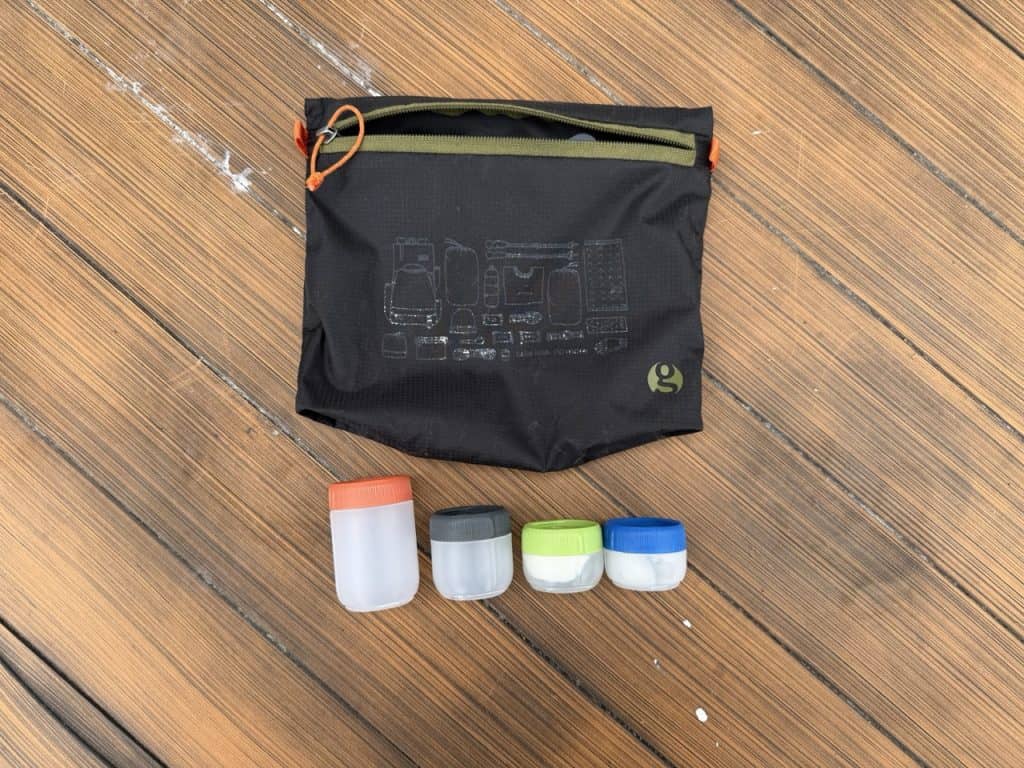
Stuff Sack to Carry Everything
I’m going to preface this with saying: I don’t actually carry everything in the stuff sack all day long.
Things I want to use during the day like sunscreen, bug spray, and chapstick are in hipbelt pockets for easy access. And my poop kit is quick-access too.
But because I mostly backpack in bear country where I need to use a bear canister for storing all of my scented items (and toiletries are scented – yes, even the unscented ones), I like to have a stuff sack for throwing everything in that also easily fits into a bear canister.
So those nice shower organizer rolls really don’t work in the backcountry. Just get a stuff sack or a ziplock for all the items.
➡️ Shop the exact shallow, wide one I use
Reusable Containers for Repackaging Toiletries
I used to just rely on travel sized toiletries, but I recently bought these small plastic containers for repackaging toothpaste, lotion, storing pills, etc. and I love them. They’re reusable and lighter than buying travel-sized versions of things – and cheaper over time too!
I think the small, short size is perfect for most week-long backpacking trips.
I have not had them leak on me yet, but if you’re concerned, you can put them in a ziploc.
➡️ Get the best ultralight containers
Ziploc Bags
I always have ziplocs on me when I’m backpacking. My poop kit goes in a separate ziploc, I have a food trash ziploc, I sometimes re-package my body wipes in a ziploc – you get the idea.
Outdoor Bathroom & Menstrual Products
Poop Kit
This is the most important toiletry item when you’re going backpacking because everyone poops! And it’s key for abiding by Leave No Trace principles.
If you’re backpacking in a place where you can bury your poop, you need to dig a 6-8” deep cat hole in soil, go in the hole, then bury it.
I keep my poop kit separate from the rest of my toiletries: either in the lid or the large mesh front stuff pocket of my backpack to keep it easy to access.
Here’s what’s in my poop kit:
- Deuce of Spades Trowel (it’s 6” long, so a good measuring tool!)
- Toilet paper (I try to budget 6-8 squares/day) – I just take from home
- 1 larger ziploc – specifically, waterproof quart size to hold the clean toilet paper
- 1 small ziploc – specifically sandwich size, inside the quart, to hold the used toilet paper
Wag Bag: In some places you actually need to pack out your human waste. Like the Mt. Whitney Zone or in the desert or above treeline. I bring one along on basically every trip now just in case I find myself in a spot where I can’t dig a hole and I can’t wait until treeline.
Bidet: This is an optional item. I wanted to mention it because I have brought and used one and do really like them, but you need to have access to water and they do take some practice in aiming. I use this ultralight one that can be affixed to a Smartwater bottle. This is a standalone option.
Pee Rag
Instead of using toilet paper, using a reusable, antimicrobial pee cloth is the way to go when you’re backpacking! This way you don’t need to pack out your wet pee toilet paper, and it keeps you more clean than drip-drying.
I use the Kula Cloth – it’s one of my favorite gear inventions and such a step-up from the bandana I used on the PCT. It easily clips on to the outside of your pack and snaps to close up to keep it clean!
➡️ Get the best pee cloth out there

Hand Sanitizer
Pretty self-explanatory. I bring a travel sized bottle of Purell and use it every time I go to the bathroom.
Some people may prefer to use real soap – I just find it inconvenient because you need to have water too. You should never go down to a stream and use your soap – even the “biodegradable” ones – in running water – it’s against Leave No Trace.
Backpacking Menstrual Products
For personal reasons, I skip my period. I believe that you don’t really need to change your period process when you’re backpacking from what you do at home. You should have enough products for the duration of your trip and maybe extra for 1-2 days for any changes in flow.
- If you use a cup, make sure you dig a cat hole and pour the fluid into the hole while emptying and clean the cup with filtered water, also into the hole.
- If using tampons or pads, bring an extra ziplock bag to pack out your used tampons, applicators, pads, and wrappings.
- If you use absorbent underwear, make sure you do all rinsing into a cat hole, not a water source.
Dental Care While Backpacking
Toothbrush
I use a small, ultralight toothbrush while backpacking. It weighs less than an ounce and works just fine! You don’t need to buy a crazy light or small brush – but I wouldn’t haul your electronic toothbrush into the backcountry.
- This is a super light model similar to what I use.
- This is a cool new invention that can transform your backpacking food spork into a toothbrush!
Toothpaste
I just squeeze a small amount of my regular toothpaste into a Stax container.
But many people like to use dehydrated toothpaste tabs – easy to just pack the right amount you need for your trip!
Floss
I bring floss picks for each day of my trip just because they’re really easy to use.
But unwaxed floss can be used for repair on a longer trip – just bring a small roll of floss – no need to overthink it! You can use your knife to cut it.

Sun Protection
I personally try to rely on my UPF clothing for the majority of my sun protection vs. needing to constantly reapply sunscreen, but I still bring sunscreen while backpacking, and I usually don’t repackage this – having more is better in this case.

Skin Care & Chafing
Here’s where we’re getting into the less essential items: but I want to mention things I bring because some of them are actually really helpful and can prevent pain, inflammation, and infection.
Anti-Chafe Cream
The best trick I learned while thru-hiking the PCT was that Vagisil is the ultimate anti-chafe ointment. Some people swear by Body Glide, diaper rash cream, Gold Bond… but I love Vagisil.
I always bring a normal tube and apply a nickel-sized amount to each inner thigh if I’m wearing shorts on my trip.
Plus, it’s multi-purpose as an anti-itch – just in case you’re having bikini line or vulva itching too.
I used Monistat when I hiked the JMT and find it works well too, but I do prefer Vagisil overall – I feel like it does a better job at healing the chafe vs. just prevention.
➡️ The best chafe prevention and healing cream
Moisturizer
I am a big fan of bringing lotion for my feet and hands on backpacking trips. Foot care is important when you’re hiking big miles, and for me, keeping my feet and hands moisturized instead of cracking in dry alpine environments, keeps them healthier and happier.
I repackage a small amount into the Stax, unless I’m on a longer trip, or in a really dry place, then I’ll bring a ~3 oz travel container.
➡️ My favorite shea butter lotion – travel size!
Sierra Stick Salve
I don’t go backpacking without the mini size in my kit (it’s also in each of my bags at home).
Sierra Stick is made out of beeswax and hemp seed oil so it’s a great natural product for moisturizing lips and knuckles. I like it better than Aquaphor.
I also use it on small scrapes, hangnails, and cuts that a bandaid won’t hold up to outside (like my hands and knees). And I’ve used it on bug bites before – the hemp seed oil helps the itch a bit!
➡️ Get 30% off my favorite salve with code backcountryemily!

Ultralight Body Cleaning Items
These are basically all non-essential items, but I will carry them most of the time. Some people prefer to use biodegradable soap – I just don’t like to deal with the mess and all the water needed and bringing all the water away from lakes and creeks.
The following items clean, and I can use them inside my tent.
Body Wipes
I use the Sea to Summit Wilderness Wipes as my bath each night before getting into my clean sleeping base layers. I start at my face and work my way top to bottom through the sensitive areas: underboob, armpits, crotch, and finally, butt crack.
I’ll occasionally use them on my arms and legs but only if I’m really dirty – I usually just try to find a creek or lake to put my legs in and just rinse off without soap though.
The downside with body wipes is you need to pack them out like trash, but I don’t find them to be too heavy, I put them in my food or TP trash bag, and only bring 1 per full day of hiking. The used wipe can also double as toilet paper.
➡️ I prefer the larger size wipes

Lemosho Rinseless Cleansers
Lemosho is a new, small, woman-owned brand that makes rinseless body cleansers. I’ve had the chance to use the hand and face cleanser and really like them!
I’ve been bringing just the face cleanser on my recent trips because it’s smaller and lighter than the foaming hand wash bottle.
It really works: just squeeze a bit on your hand, rub it in circles on your face, and wipe it off with your small towel or buff. The dirt really comes off – no water needed! And my face feels nearly as smooth as when I do my 2-step skincare cleansing at home.
I’ve also used the face cleanser on my armpits, underboob, and crotch – I’ve just rubbed it in and not wiped it off. I find that it keeps me smelling fresher even without using deodorant.
➡️ Get 15% off with code EMILY15 and feel more clean and fresh with less waste

Bug Protection
You won’t always need to bring bug spray on your backpacking trips, but I wanted to mention it because I consider it an essential, especially early summer in the mountains and anywhere where ticks are prevalent.
I try to treat my clothing ahead of time with permethrin since it works really well at keeping mosquitoes and ticks at bay. You can also treat your tent and backpack with the spray too!
I use Picaradin spray on the trail. This is pretty hard to re-package so I usually just bring the full 3 oz. bottle. Some people will bring DEET – I just prefer Picaridin since it won’t ruin my gear if it leaks.
Ultralight Personal Care Extras
These are all optional items, but some people might find them helpful and comforting. I will bring them on certain trips.
- Hair ties: I always pack an extra in my bag in case mine breaks!
- Eyedrops: I have dry eye, so eye drops for nighttime are a must.
- Earplugs: Small, foam earplugs are crazy light and can really help sleep quality. I always bring them now in group settings.
- Tweezers: I bring this small set to pluck errant hairs, but they’re obviously helpful for first aid too: cactus spines, splinters, ticks, etc!
- Hair brush/comb: I don’t usually bring this, opting to finger-comb my hair or use braids, but I’ll never begrudge someone for doing so! Chicken Tramper Gear makes a super light option.

My Ultralight Backpacking Toiletry Kit After 10 Years of Field Testing
The full weight of everything below, including the “sometimes” items: 1.5 lbs.
Remember, you shouldn’t be bringing your entire self-care kit into the backcountry: it’ll be so heavy. Prioritize hygiene, prevention, and the few comfort items that will genuinely make you happier on trail. And stick to non-scented items when you can!
Bathroom
Dental
Skin
- Sunscreen stick
- SPF Lip balm
- Lotion in small Stax
- Vagisil tube
- Sierra Stick salve
- Body Wipes – 1x day in ziploc bag
Extras
Condition Dependent & Sometimes
- Wag Bag
- Picaradin bug spray
- Sunscreen lotion (larger bottle)
- Lemosho face cleanser
- Earplugs
- Travel brush
And if you’re trying to keep things light and minimal, start with the absolute essentials and add only the comfort products that solve a problem you personally have. And seriously, repackage your supplies – I can’t believe I waited so long to buy the Stax containers – they’re a game changer!
