
Gossamer Gear The One Review: Best Value UL Tent
After putting many holes in the rainfly of an expensive DCF tent during my PCT thru-hike, I needed another tent for my backpacking adventures and I really didn’t want to spend another $500+ on a tent quite yet.
And the Gossamer Gear The One stood out to me as an ultralight option that wasn’t going to break the bank.
I had some doubts originally. It was a few ounces heavier than my other tent, made of a different material, needed 2 trekking poles to set up but was just a one-person tent, and I questioned if it would be worse with condensation.
But after using The One for over 5 years and taking it thru-hiking on the Colorado Trail during a “super monsoon” summer, down to the windy Torres del Paine National Park on the O Circuit, and lots of summer Sierra backpacking trips, I have not felt the need to have my old tent back.
If you’re someone who is looking to lighten your backpacking tent for your solo backpacking adventures but can’t fathom paying over $700 for the lightest on the market, The One should be on your short list as one of the lightest tents for the price point out there.
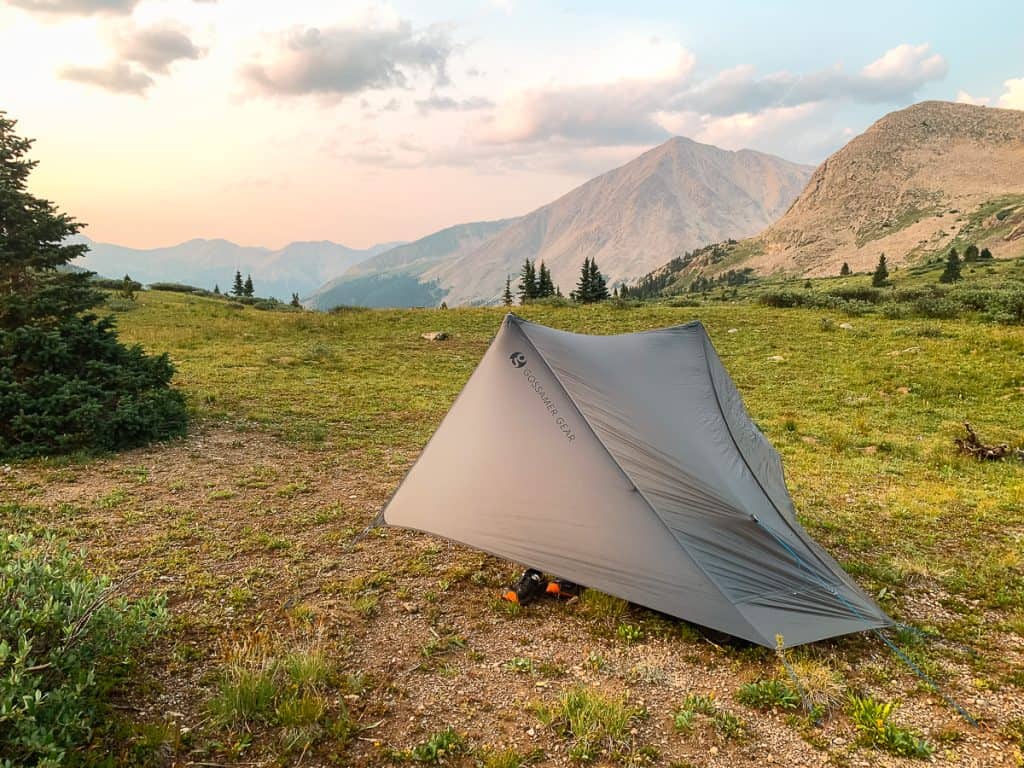
Backcountry Emily contains affiliate links, and I may earn a commission—at no extra cost to you. Some gear in this post may have been gifted or part of a paid collaboration, but I never accept products or partnerships I wouldn’t personally recommend. All opinions are 100% my own. As an Amazon Associate, I earn from qualifying purchases. See my Privacy Policy for more information.
Gossamer Gear The One Specs At-a-Glance
The One tent was updated for 2026, so these are the current specs of the tent. I have the earlier model and will be speaking to that tent, but can say based on the updates Gossamer Gear has made, I want this model even more than my current one (those new ceiling vents)!
- Price: $315
- Capacity & design: One-person, single-wall trekking pole tent
- Shelter Weight: 19.68 oz (558 g)
- Weight w/ all included accessories: 22.24 oz (630 g) total
- Floor dimensions: 84″ long × 33″ wide at the head, tapering to 21″ at the foot
- Peak interior height: 49″
- Packed size: 12″ × 5″ × 5″
- Material: PFAS-free ClearSkies™ 15D recycled Robic nylon with a 20D ripstop grid and silicone/PU coating
- Waterproofing: Factory-taped seams and a 4,923 mm hydrostatic head rating
- Setup: Requires two trekking poles set to 125 cm or a dedicated pole set, sold separately
- Key features: Retractable vents, water-repellent fly zipper, interior mesh pocket, and adjustable Fritsch Hitch guyline system
- Included: Six aluminum stakes, stuff sacks, two extra guylines, and a clothesline
Verdict: The One is my go-to for solo, ultralight backpacking. If you’re under 6’ and use trekking poles, it’s the best balance of weight, price, and weather resistance I’ve found.
- Pros: Light, affordable, packs small, repairable
- Cons: Not for tall hikers, requires trekking poles, typical single wall condensation

Why I’ve Backpacked With The One Tent For Over 5 Years
Simply put, The One works with how I backpack when I’m hiking solo. It’s the right amount of interior space as a shorter hiker (5’4”) to also store my gear inside the tent (and sometimes a 60 lb. snuggly Labrador Retriever).
I use a 40 liter ultralight backpack, so the fact it packs down super small when I’m also shoving a bear canister into my backpack is a huge plus. I also always hike with trekking poles, so using those as the tent poles just saves more weight!
The One stood up to the rain on my Colorado Trail thru-hike and backpacking the gusty O Circuit in Chile really well, so I don’t have qualms bringing it along in harsh conditions.
Ultralight gear like The One can be more fragile, which I’ll get into below, but I’ve always been able to repair The One when I’ve been a little rough with it. I can easily patch it with Tenacious Tape in the field if I rip a hole (like when I forgot a groundsheet). And I was able to get the fly door zipper replaced after ~600 miles of use.
All single-wall, non-freestanding tents like The One are going to have some drawbacks and trade-offs when you’re comparing them to the (much heavier) more durable, freestanding tents, but for me, those trade-offs are so worth it to carry a 19 oz tent vs. one twice its weight.
The Features That Make The One the Best Budget Ultralight Tent
The One isn’t the lightest backpacking tent on the market. It also isn’t the cheapest.
But I think it’s the tent that strikes the best balance of weight, price, and features, and gets you the closest to the lightest tents out there – without paying an arm and a leg.
Weight to Cost Ratio
The One shelter weighs 19.68 oz. without the accessories & stakes. Which is what I want to compare because a lot of UL tents on the market don’t come with stakes or extra guylines, and it costs $315.
Lighter tents of a similar style, like the Zpacks Plex Solo Pro, weighs 13.2 oz., but costs $649. A similarly spec’d new model by Big Agnes weighs 19 oz, but costs $550.
On the other end, less expensive options like the Durston X-Mid 1 are 26.2 oz for $269. The 40 oz, $160 Skyscape Scout by Six Moons Designs is another example of a heavier, less expensive model.
These tents don’t all have exactly the same specs and they’re made of different materials in some cases, and they’re all going to have slightly different features, so this can’t exactly be apples to apples.
But I do think these face-value weight to price comparisons paint the picture that The One is an amazing value for the price.

The One Can Withstand Harsh Conditions
The first big trip I took The One on was my Colorado Trail thru-hike in 2021. That year ended up being a “super monsoon” summer and every local I hitch-hiked with commented on the rain and asked how I was holding up.
Luckily, The One did as well as I expected a single-wall tent to do in those conditions. Yes, the whole tent was wet after it rained all night long. But it packed down small enough to put in my outer backpack mesh pocket and I’d lay it out to dry when the sun came out, and it dried quickly. Just like I’d do with my other tent on the PCT.
I also took The One with me to Patagonia to hike the O Circuit and backpack the Los Glaciares Loop in El Chaltén – two places that are notoriously windy. And The One stayed standing, even when I watched another (heavier, freestanding) tent get ripped out of the ground at the windy Dickson camp.
I still got a lot of dirt blown into my tent from the unrelenting wind, but so did my friends in their Big Agnes tent. You’d need a solid-walled, four-season tent to combat that.
The One can hold up to strong winds and rain, but the key is knowing how to pitch it properly, with the narrow side facing into the wind, and using the environment to your advantage.
Every single wall, trekking pole tent is going to have similar downsides when you’re comparing it to a double wall, freestanding tent – but getting the education for proper campsite selection and pitching helps a ton.
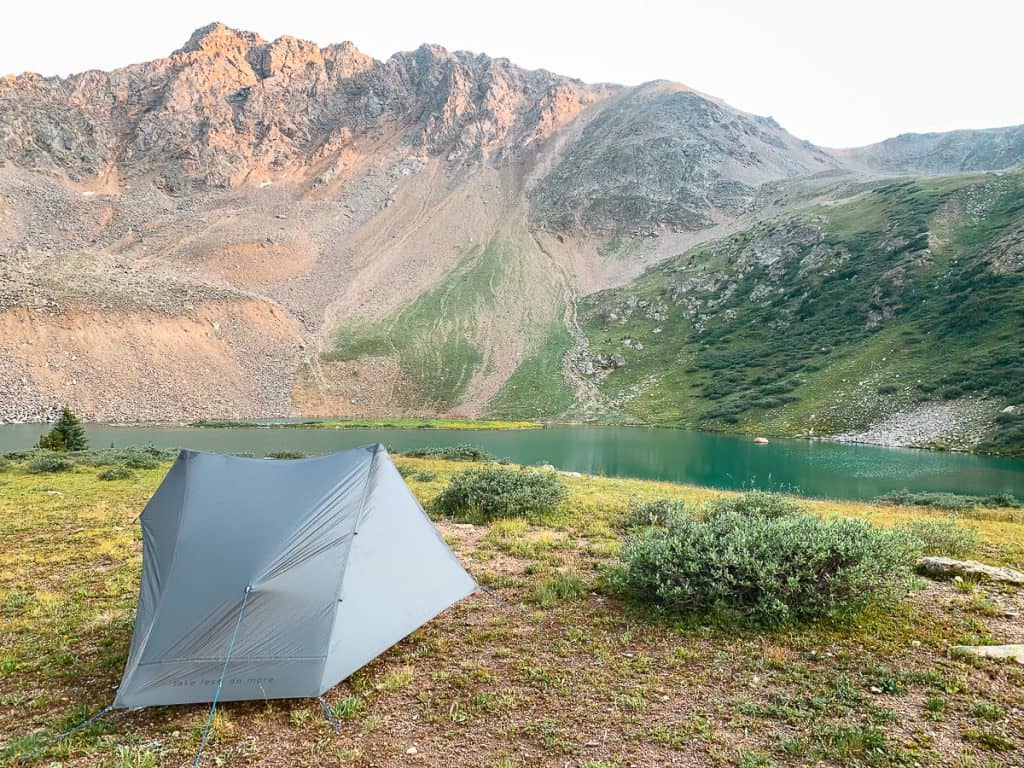
It Packs Down Small
I love how small I can bunch this tent up – in its stuff sack and out of it.
I am usually backpacking in the Sierra with The One, and I need to bring a bear canister with me, which takes up so much room in my backpack, and can awkwardly shift around if it’s not packed well.
So with The One, I am able to pack my bear canister vertically in my pack and stuff it around the canister to stabilize it and reduce awkward movement. This also saves vertical space in the pack, allowing me to use a smaller volume of backpack, and therefore, a lighter pack.
My former 2 person DCF tent was so much harder to pack down small: and it never nicely molded around my bear canister in my pack. This is just the way that the fabrics differ, but it’s something to be aware of. Silnylon/Silpoly packs smaller than DCF.
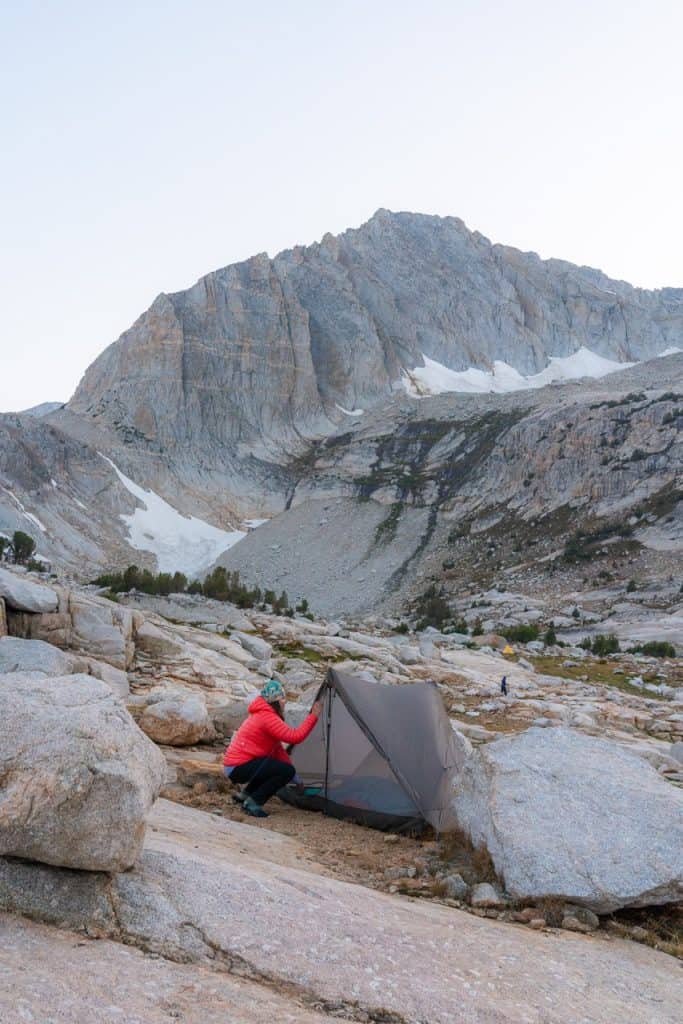
It’s Easy to Set Up as a Non-freestanding Tent
The One only needs 6 stakes to fully set up, 8 if you’re attaching the side wall guylines, which I do recommend.
Gossamer Gear also made it easy to get a good pitch with The One with 2 extra features I don’t see on a lot of UL tents.
First, the exterior floor webbing loops where the trekking poles stand up. Putting your trekking pole bottom into these loops helps the tent floor expand and keep its shape, while also making sure your trekking pole is in the correct position for a secure pitch.
Since your trekking poles are providing the major support of the entire tent, this is a key feature to help you get a good pitch, every time.
The second small feature are the mesh door toggles that also connect to your trekking pole quickly. This little feature is overlooked, but it’s super handy on windy nights to secure the inner tent body more.
Another small, overlooked feature are the guyline tensioners. Sometimes these can just suck, or the guylines are so thin, it’s hard to get them to grab, but these tensioners combined with the guyline material are nice and sticky: I have no issues adjusting the guylines or getting them to stay put with an adjustment.
The extra-long guylines and adaptable design also make it so easy to move your stake over a few inches if you’ve got a big rock or tree root in the way. A few inches won’t ruin your pitch, which is so nice when you can’t guarantee the perfect campsite every night or you’re sharing a spot with multiple people.
It took me a couple of pitches to really nail down the right angles – especially of the 4 corners – even though I was experienced setting up nonfreestanding tents, but all of these tents are going to have their little quirks and I do think the floor webbing loops are incredibly helpful to have vs. floating bathtub floors.
Like all non-freestanding tents, pitching on solid rock can be difficult to overcome, especially if you’re just learning, but once I adopted the “big rock, little rock” method for staking, I have never had a problem. The only times I have had a tent collapse is when I have been lazy with this on solid rock.
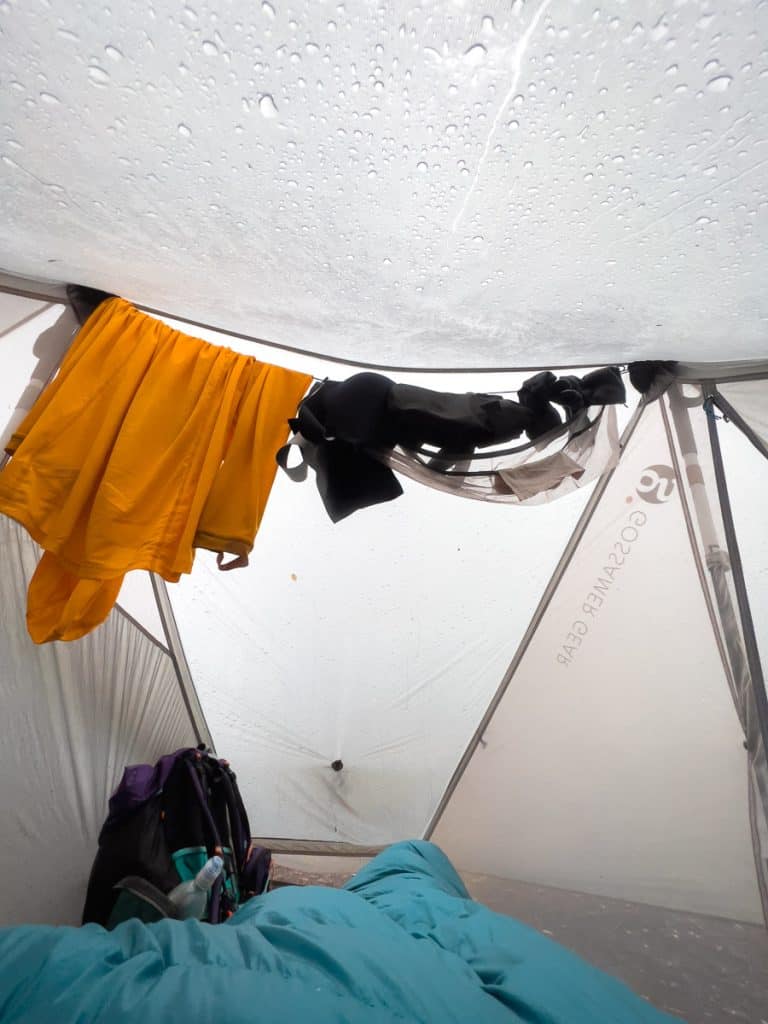
Lots of Headroom
The One stands tall at 49”! I’m only 5’4” so I have loads of ceiling space when I’m just sitting in my tent. This is great for liveability, but also great for airflow.
If you’re going to use the included clothesline and hang up your socks and underwear to dry/ air out after a day of hiking, having them further from your head overnight is a nice treat too.
More headroom and airspace above your head also helps with airflow, which can help with reducing condensation.
2026 Tent Updates
I want to briefly mention the new tent updates. Even though I haven’t had the chance to use the new version of the tent, I can see how these updates increase the value even more.
- New ridge vent: Combined with the retained mesh fabric vent on the opposite wall, this is going to increase airflow and reduce condensation when you need to keep your vestibule doors closed overnight.
- New Fritsch Hitch guyline system: Previously, the 4 corners of the tent bathtub were unattached to the fly corner staking. You could bring small shepherd-hook stakes and stake them separately if you wanted, or DIY-attach paracord to the small loops and connect them to the corner stake. But this new system basically does that for you, which is going to make your tent floor more taut and maximize the bathtub space.
- New Fabric: The new fabric being sil/poly coated will definitely reduce sagging of the tent in harsh rain conditions and help the tent dry quicker post-rain.
Want the best value ultralight tent for solo backpacking? See if The One is in stock now →

Who Should Buy the Gossamer Gear The One Backpacking Tent
The One is for solo backpackers who want to lighten their pack and understand and are comfortable with the tradeoffs that come with any single-wall, non-freestanding tent.
It’s the tent for you if you’re looking for the most value your money can buy, without breaking the bank. Finding a sub-20 oz shelter at $315 that holds up to long distance thru-hiking and adverse weather conditions is a bargain, in my opinion.
If you walked into REI with that budget, you’re looking at a 4-5 pound tent – or you’ll shell out $100-200 more for a 2-3 pound option – still heavier than The One!
|
Pros: |
Cons: |
|---|---|

Reasons You Might Want to Consider Another Backpacking Tent
The One won’t be the perfect fit for every solo backpacker out there. If you’re taller than 6’, don’t use trekking poles, regularly bushwack or camp in really rough conditions, or just can’t stand the thought of wiping up condensation in the morning, you might want to look elsewhere.
Condensation
All single wall tents struggle with condensation, especially if you’re like me, and don’t scope out the “perfect” campsite every night to reduce the likelihood of condensation on the side walls.
But The One does have a solid side wall with a small triangle of mesh to help with ventilation – instead of a full mesh side wall like the door side. This design choice was made to save weight by avoiding a full vestibule on the non-door side, or having a dual door entry.
This solid wall can decrease airflow, which can increase condensation. You can combat this by rolling back 1 or both of the main vestibule doors. I’ve never had a problem with dripping-on-my-face level of condensation overnight, but I also generally backpack in more arid environments.
The new version of The One with the added ceiling vent also may mitigate condensation more.
I always carry a small towel to wipe up condensation in the morning and it’s just something I’ve learned to deal with in a single wall tent. And in my opinion, it’s actually easier to wipe up condensation in a single wall tent than a double wall tent.
Durability
All ultralight tents are looking for ways to get lighter without compromising too much durability. You’ll see it with thinner fabric and smaller zipper pulls.
My version of The One has a 10-denier fabric for the floor, making it pretty susceptible to rips, especially if you fail to clear the ground of sharp rocks or sticks or forget to bring a groundsheet. I have gotten small tears in my floor fabric, but they’ve been easily repaired by using Tenacious Tape.
The new tent fabric is a 15-denier Robic nylon and 20-denier ripstop grid blend, so on paper, it appears to be more durable than my model.
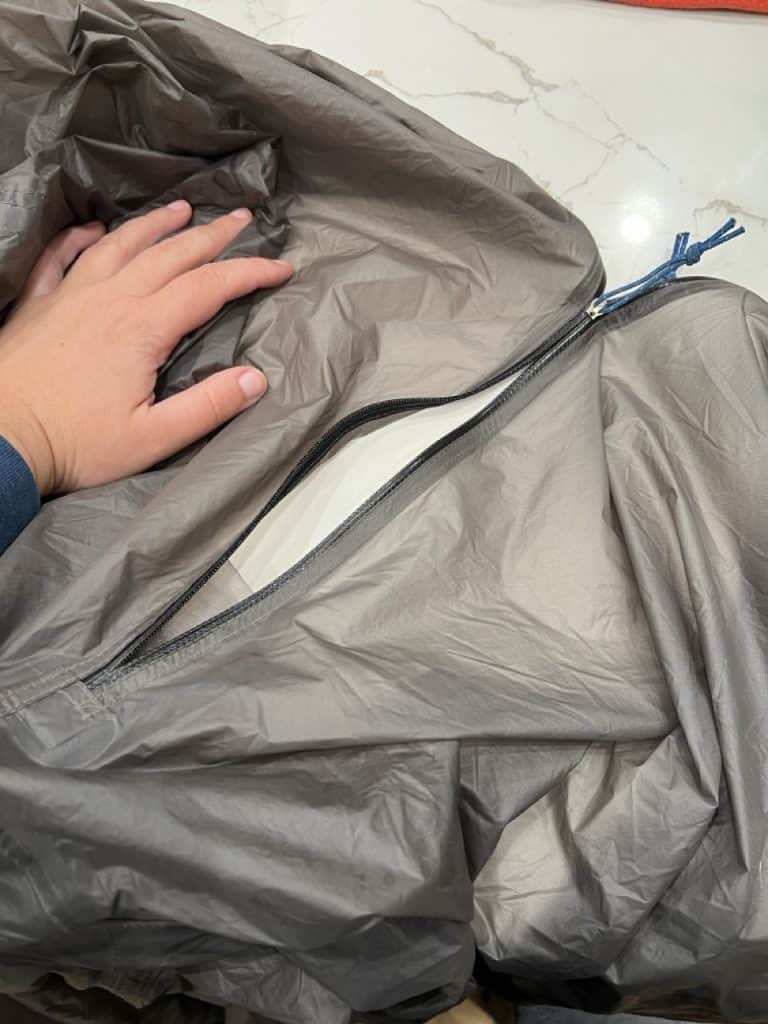
After my trip to Patagonia, I did have an issue with the main fly zipper door with the teeth separating. I tried to use lubricant to fix it and other DIY zipper fixes, but ultimately with the taped zipper, I sent it to Rugged Thread for replacement, who partner with Gossamer Gear and have repair discounts on Gossamer Gear-branded items.
Currently, my 5 year old tent’s main mesh door zipper is separating in that annoying way that you can only zip it in one direction: a common zipper issue that I’ve been too lazy to sit down and repair myself (on the winter to-do list). It’s not a huge issue, I just wanted to note it.

Liveable Space
When I set up my 3-inch tall, 20-inch wide, 66-inch long inflatable sleeping pad and quilt, I do not touch the walls of the tent. There is a bit of space on each side of me, and a decent amount of head or foot space, whichever way you want to look at it.
I am able to bring my backpack and shoes in the tent with me at night, and usually place them at my feet. I can also fit my electronics bag and both of my water bottles on my sides.
I’ve also brought my 60 lb dog backpacking with me in this tent, and we were quite snug, but we made it work (I did not have any of my extra gear in the tent, in this instance).
If your dimensions are larger than mine, you might want to look for a wider or longer tent, like the Gossamer Gear The Two.
No Trekking Poles
If you don’t hike with trekking poles, a lot of the weight savings of trekking-pole supported tents kind of disappears. Of course, you can still use these style of tents, but you’ll need to buy an extra pole set to set it up – which costs more money and weighs more.
The poles don’t weigh as much as a traditional freestanding tent because there’s less material, so it doesn’t entirely defeat the weight purpose, but there are some freestanding, double-walled tents that could be much closer in weight to The One + poleset than The One + your trekking poles that you’re already using.
Why I Pick The One For Solo Backpacking and Thru-Hiking
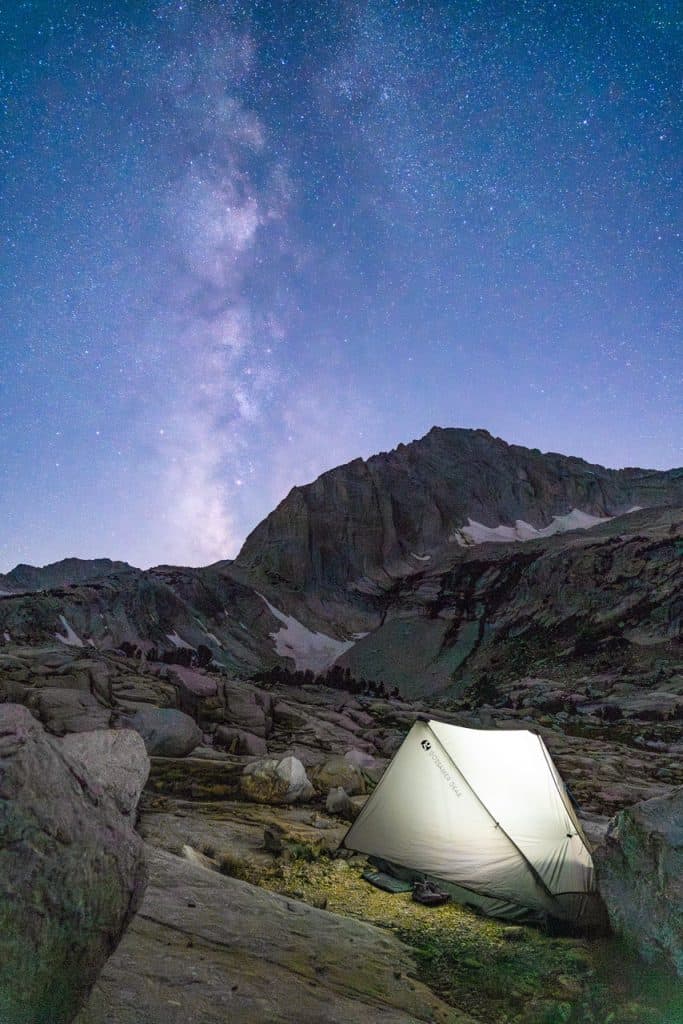
The One is my go-to tent because it’s ultralight, perfectly sized for me, and easy to pitch and fit into smaller tent sites.
Sometimes when I’m backpacking solo, I’ll grab The One’s big sister (The Two) just to compare and see if I miss the bigger size, and… I don’t. Saving over half a pound of weight in my pack matters more to me when I’m hiking long miles all day than having a smidge more space in my tent.
🏕️ If you’re looking for a no-fuss, lightweight tent that can handle real trails and real storms, The One is my top pick. See specs, more reviews, and current price here →